
Darkness Visible (Extract)
An Extract from the book Darkness Visible: the Cinema of Jonathan Glazer

Jonathan Glazer has released four feature films as director: Sexy Beast (2000), Birth (2004), Under the Skin (2013) and The Zone of Interest (2023). He has also directed numerous commercials, as well as a handful of shorts and music videos.
Darkness is a key element in his films and work generally. It isn’t there as a general Fincher-esque aesthetic choice; there is plenty of daylight as well as colour. Rather, darkness exists in Glazer’s films as a tangible presence. It is, at times, visible. Neither is it a part of his philosophy or outlook. Glazer is assuredly not a nihilist. In his worlds, love is not just possible, it is vital and motivating. His darkest characters are striking for not being nihilists. His evildoers are not (at least by their own estimation) evil. And yet they do evil. So perhaps they are evil after all.
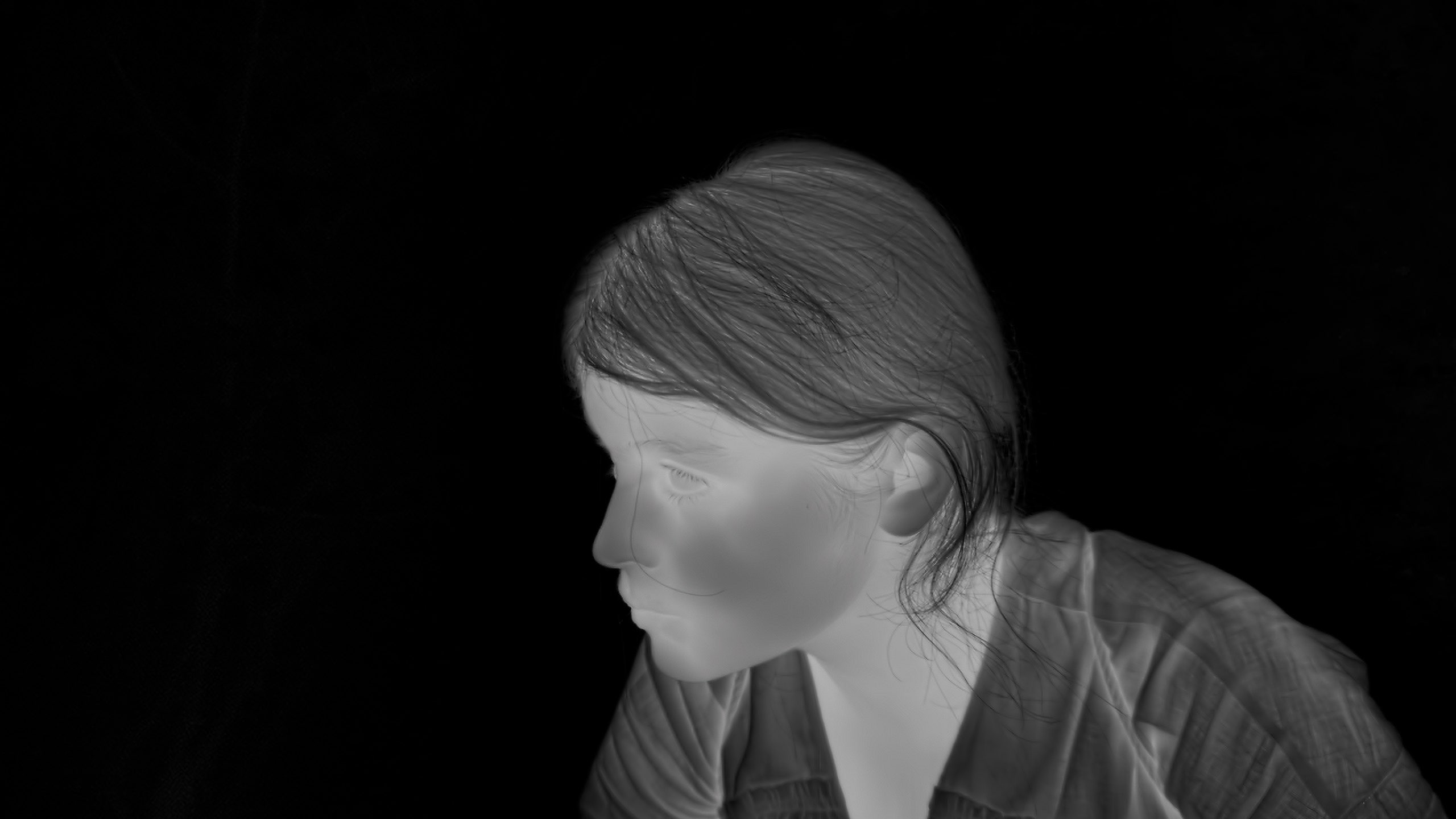
It is relatively easy to point to the visible darknesses in his quartet of films. The criminal underworld of Sexy Beast is a literal underground, where bodies are buried and creatures of the unconscious scrabble at the soil with long fingernails. In Birth, the bridge under which a man jogs is another underground, a tunnel in itself a gateway to the underworld between life and death. Is this a place from which you can return? That will be the mystery of the film. The black space of the alien honey trap of Under the Skin sucks light to an event horizon, a black hole made of goo. Musou black paint, developed in 2020, is now the world’s blackest paint, absorbing 90 percent of light. Glazer’s blacks are not that black, but they are still very black. His films are experiments in intensity. Outer space is an inner space: a gunk hole, anticipating the title of Charlie Booker’s British TV show Black Mirror. And, finally, the darkness of The Zone of Interest is the theme of the film and its subject: the Holocaust. There are several moments where this is visualised, but none more clearly than the poster which advertised the film, and which features a garden party at the Höss family home. Everything beyond the garden fence – the sky, the camp, the surroundings – is blacked out as if redacted. This could almost be another of Glazer’s science fiction films and the family is on some alien planet, living in a replica of a family life. It is something Tarkovsky might reveal at the end of Solaris (1972). Glazer’s relationship with genre will be something we come back to, but for the moment I shall note here that he makes science fiction films like documentaries and realist drama like science fiction.
Darkness is not only visible in Glazer’s films, it is also audible. His use of discordant elements and silences which swallow sound in his soundtracks adds an aural corollary to the darkness. The sound we hear frequently comes from things happening which we do not see or cannot see, like the noises off which Stanley Kubrick references in his spacey hotel room at the end of 2001: a Space Odyssey (1968). The out of sight noises, the unseen voices, is this not also a sort of darkness? Arguably, the main drama of The Zone of Interest happens off screen but in our ears. Glazer’s creative collaborations with composers Alexander Desplat and Mica Levi have intensified these experiments.
Thematically, Glazer’s films present a universe of Manichean duality. Love can be a beautiful refuge from crime, hatred and violence, as in Sexy Beast, or it can be steeped in crime, hatred and violence. The return of the repressed, be it a nightmare bunny man (Sexy Beast) or smoke from burning bodies (The Zone of Interest), is always threatened and sometimes realised. Evil can be present as a source of darkness. Sexy Beast’s Don (Ben Kingsley) is a loud-mouthed, voluble vandal of chaos, an immediate terrifying danger to the domestic expat paradise that Ray Wilkinson’s Gal has created. But Ian McShane’s Prince of Darkness is the glowering ultimate presence. The Höss household is the reductio ad absurdum of Hannah Arendt’s truism about the “banality of evil,” which is so oft-repeated as to risk becoming, well, banal. The portrayal evokes empathy for the worst perpetrators of the worst crimes against humanity.
Darkness can evoke a universe, in the words of Frederick Nietzsche, “beyond good and evil,” where merely human ethical categories break down, and are as radically and thoroughly dissolved as the bodies of Scarlett Johansson’s victims in Under the Skin. Darkness can be death. The emptiness left by a human presence: a love-shaped hole punched in the universe by grief.
And yet – this is an important point to make early on – Jonathan Glazer’s films are not dark. They are colourful, bright, sharply, often beautifully, photographed (6K digital) and scored, with humour and wit, all enriched with what one literary critic, referring to Hamlet, once called “a variety of incident.”
A teacher of mine at the University of Liverpool, Prof. Brian Nellist, told me, when I tried to fold a novel which I was studying into a predetermined political point I wanted to make, that “life is wider than argument.” It’s a phrase that has stayed with me. How easy it is to get an angle, an entry point, on an artist, then go in search of the evidence to shore it up, ignoring everything that is inconveniently contradicting you. It’s something that Glazer himself referred to in an interview: “You don’t write themes; themes come up through the cracks.”
I want this book to be an exploration and an appreciation, more than I want it to be an argument. I want it to take in the breadth of Glazer’s cinema rather than convince you of a particular thesis. And so, if darkness goes missing from time to time – slopes off into the shadows, so to speak – so be it. If anything doesn’t fit my ideas, I would prefer to be inconsistent rather than incomplete or insincere. But I do see that there is a consistency in Glazer’s work, despite the long gaps between his films, and despite the small numbers of films and different genres: a gangster film, a quasi-supernatural thriller, a science fiction movie, an experimental Holocaust drama. The consistency comes from the threatening darkness that nibbles at the flames of the campfire, that menaces the family and us as individuals. It can be historical and existential, it can come from outer space and be utterly alien, or from come from deep within us and be all too human.
Darkness Visible: the Cinema of Jonathan Glazer is available from Sticking Place Books, here.